Product Design · UX/UI

Bunadh
App

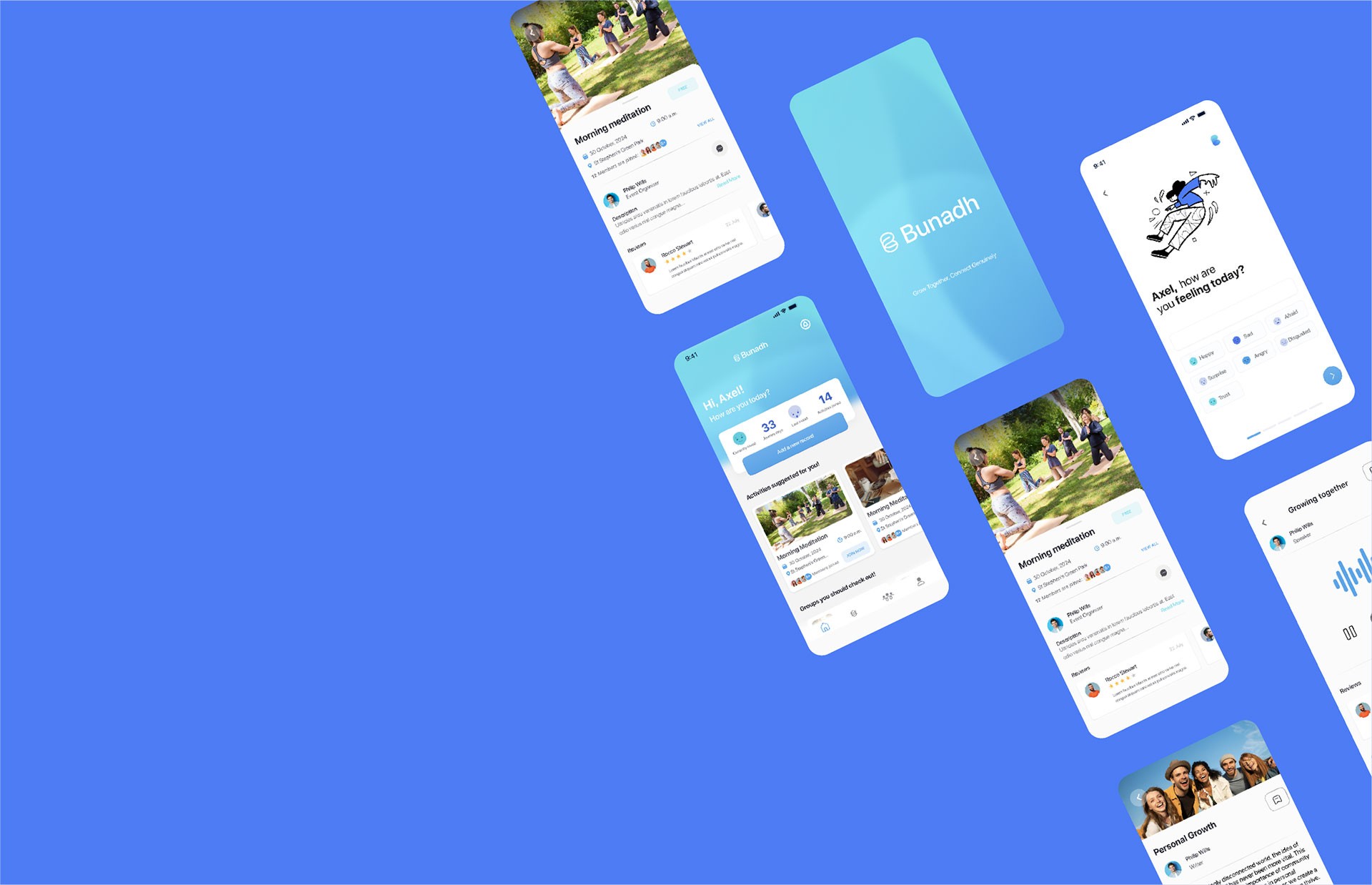
Nobody hands you a manual for a breakup. This app is the closest thing to one, built from real research on how people actually heal.

Duration

4 Weeks

Role

Interaction
Designer

Duration

4 Weeks

Tools Used

Figma, Ai
& Ae

Deliverable

Mobile App

Role

Interaction
Designer

Tools Used

Figma, Ai & Ae

Deliverable

Mobile app

Year

2024

Product Design · UX/UI

Bunadh
App

Nobody hands you a manual for a breakup. This app is the closest thing to one, built from real research on how people actually heal.

Duration

4 Weeks

Role

Interaction
Designer

Duration

4 Weeks

Tools Used

Figma, Ai
& Ae

Deliverable

Mobile App

Year

2024

Tools Used

Figma, Ai & Ae

Deliverable

Mobile app

Year

2024

Product Design · UX/UI

Bunadh
App

Nobody hands you a manual for a breakup. This app is the closest thing to one, built from real research on how people actually heal.

Duration

4 Weeks

Role

Interaction
Designer

Duration

4 Weeks

Tools Used

Figma, Ai
& Ae

Deliverable

Mobile App

Role

Interaction
Designer

Tools Used

Figma, Ai & Ae

Deliverable

Mobile app

Year

2024

No headings found on page

Brief

THE BRIEF

The brief sat inside a bigger theme: love in the age of technology, before it,
finding it, keeping it, and after it. The team chose the last one. Life After Love.

The brief sat inside a bigger theme: love in the age of technology, before it, finding it, keeping it, and after it. The team chose the last one. Life After Love.

Design a tool that offers gentle, actionable
support for people navigating a breakup,
intuitive, emotionally intelligent, and rooted in
what genuinely helps someone heal.

Design a tool that offers gentle, actionable
support for people navigating a breakup,
intuitive, emotionally intelligent, and rooted in
what genuinely helps someone heal.

Design a tool that offers gentle, actionable support for people navigating a breakup, intuitive, emotionally intelligent, and rooted in what genuinely helps someone heal.

Nobody hands you a manual for a breakup…

Research

RESEARCH

Under that name, the team went looking for real answers, not assumptions, interviews and open conversations with close to 25 people, mostly in their twenties, plus secondary research across articles and existing media on the topic.

100%

had experienced a break-up before

92%

said friends helped them through it

75%

tried keeping a diary, then gave up

80%

felt their emotions weren't "valid"

75%

tried keeping a diary, then gave up

80%

felt their emotions weren't "valid"

70%

feeling understood was a turning point

100%

wanted to understand themselves


80%

said new habits helped them heal

72%

felt left behind by friends moving on

80%

said new habits helped them heal

72%

felt left behind by friends moving on

Three things kept repeating: validation, structure, self-understanding. Each of us on the team built a persona from all of it, a single profile to design against. I took Axel, the finding that pulled me toward him was that new experiences helped people heal. That's the part I recognised most.

User Persona

Axel Brown

Age

24
Years

24
Years

24
Years

Status

Single

Single

Single

Occupation

Drummer

Drummer Player

Drummer

Location

Dublin

Dublin

Dublin

Bio

Axel is a 24-year-old drummer living in Dublin…

Needs

• Self-awareness: Axel is looking for tools that help…

Quotes

"I thought we were going to last, but I've realised it was a toxic…

Pain Points

• Emotional confusion: After the breakup, Axel feels uncertain…

Scenario

Axel is a musician who, three months after his breakup…

Ideal Experience

• Personalized meditation tools: Axel would love access…

• Personalized meditation tools…

What it surfaced:
A fear of repeating old patterns, loneliness despite a full social life, and a need to feel like himself again, the same isolation the wider group had described, now visible up close in one person.

Then I mapped his journey to find out when, not just what. The lowest points weren't right after the breakup. They came back around three months, and again at six, right when the initial support from friends usually fades. That's where a product needed to step in.

Sensemaking

SENSEMAKING

This is where understanding Axel turned into a direction.
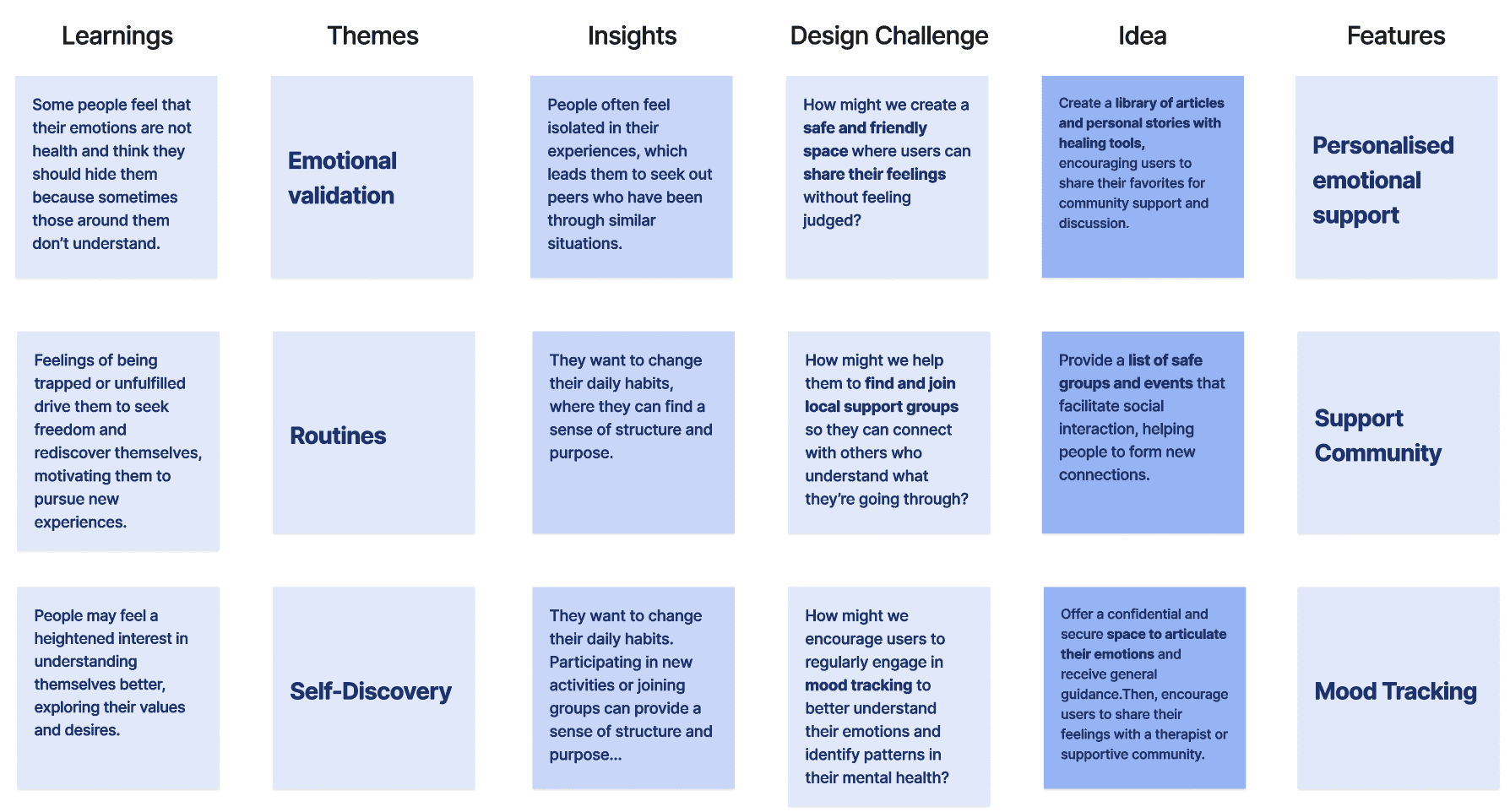
Three features came out of that. Together, they formed a single concept: Support Community to Reflect, tailored guidance, people who'd been through the same thing, and space to check in with yourself. That became the starting point for every flow and component that followed.


Storyboard
Working from that concept, I storyboarded Axel's first contact with the app,
start to finish.

Eleven scenes:
overwhelmed enough to start searching, finding it, downloading it, and walking through it for the first time, right up to the moment he closes it, feeling lighter.

Developing

DEVELOPING

Now it was a brief of my own: build that story as an app.

Understanding that concept and the three features, I set four principles to keep every decision honest from here on: understanding, not overbearing. Smart, not showy. Minimalist, not insignificant. Inspiring, not extravagant.

Site Map

Iteration 01

Iteration 2


Those ideas shaped everything that came next, the graphic identity, and the logic behind the first sketches of the user flow.

Naming

Color Palettes

Typography

Logo Variations

Illustrations


This word in

Irish Gaelic

refers to a group of people who come together, often sharing common interests or bonds.

Bunadh implies a sense of camaraderie, support, and connection among members.


This informal term highlights the idea of togetherness and unity within a community,

suggesting that each individual contributes

to the strength and dynamic of the whole group.

Testing & Iteration

TESTING & ITERATION

Now it had to survive contact with real people.

Five sets of paper prototypes, walked through with real people, one flow at a time. The same two questions guiding every session: did this feel right, and could they get through it without help.

User Flow

Onboarding

Home

Community Screen

Journal Screen


Six decisions, traced straight back to what people actually said. That's what carried into the final screens.

Outcome

OUTCOME

This is Bunadh, screen by screen.


And this is it, moving the product and the thinking behind it, together.

Reflection

REFLECTION

Bunadh was never meant to replace therapy, it says so on its own welcome screen. It set out to give people a space to process a breakup that doesn't feel like homework. That's exactly what the research asked for.

People who walked through the prototype called it practical, easy to use, optimal for what it was trying to do. More than one described it as something that made healing feel less solitary, less like a task to manage alone, more like something to move through with others. That's the part that mattered most: the idea wasn't just usable, it was landing emotionally.

Mood tracking pulled the most attention of anything in the app, and it's the piece I'd go back to first. Right now, it's still built on prompts, pick a feeling, rate a factor. Given more time, I'd want to run a co-design workshop with people further along in their healing, not just to ask better questions, but to test other ways of capturing how someone feels: a colour they'd pick without thinking, a short voice note instead of a form, a gesture or a photo of their day. Something closer to how people actually process a hard week than a checklist ever could be. That's the version of Bunadh I'd want to build next.

The other place I'd push harder: community moderation. A support app lives or dies on how safe that space actually feels, and that's not something a four-week project gets to prove on its own.

Credits

CREDITS

Photography — a mix of original photos and stock from magnific.com
Video — a mix of original footage and stock from Pixabay
Music — "For Her" by Lidérc, via Pixabay
Voiceover — generated with ElevenLabs
Illustrations — Pablo Stanley, via Blush Design

Create a free website with Framer, the website builder loved by startups, designers and agencies.